Upload 10+ Photos: Copilot Ready Bing Places Optimization for Agencies
Published September 3, 2026
Upload 10+ Photos: Copilot Ready Bing Places Optimization for Agencies

Claim your Bing Places listing, verify it through Google import or Domain Connect, and complete every field before you touch anything else. That single sequence, done correctly, resolves most of the visibility gaps small and multi-location businesses have on Bing. From there, prioritize reviews on the platforms Bing actually aggregates and keep your name, address, and phone number identical across every directory.
TL;DR:
- Claim and verify Bing Places listings using Google import for instant verification, or through DNS or postcard methods, avoiding duplicate profiles.
- Focus on completing all profile fields, especially primary categories, services, attributes, accurate hours, and location-specific website URLs.
- Upload at least 10, ideally 25 or more, high-quality photos in accepted formats, including exterior, interior, team, and product shots, with geotagging if possible.
- Pursue reviews on Yelp, Facebook, and TripAdvisor, and respond promptly to all feedback to signal active management and improve trustworthiness.
- Maintain a consistent, complete, and current listing by regular quarterly updates on photos, hours, reviews, and attributes to prevent decay and support Bing’s AI-driven recommendations.
Table of Contents
- What Should Be On Your Bing Places Optimization Checklist?
- How Do You Claim And Verify A Bing Places Listing?
- Which Profile Fields Have The Biggest Impact On Rankings?
- How Many Photos And What Format Does Bing Places Require?
- How Does Bing Handle Reviews From Yelp, Facebook, And TripAdvisor?
- How Do You Manage Bulk Uploads For Multiple Locations?
- How Should You Optimize A Bing Business Listing For Copilot?
- Why Do Bing Places Edits Fail To Save, And How Do You Fix Spam Listings?
- What We’ve Learned Managing Bing Places Across Multi-Location Clients
- How Local SEO Bot Supports Your Bing Places Strategy
- Primary Sources And Further Reading
- Sources
What Should Be On Your Bing Places Optimization Checklist?
Most business owners treat Bing Places as an afterthought after setting up Google Business Profile. That’s a mistake, especially since Bing still holds a meaningful share of global search traffic and now powers Copilot’s local recommendations. Here’s what to knock out first, in order of impact.
- Claim and verify the listing. Use Google import if you already manage a Google Business Profile, or verify through Domain Connect if you control your website’s DNS settings.
- Pick one precise primary category. Vague categories confuse both Bing’s algorithm and Copilot’s filtering logic.
- Fill in every secondary field. Hours, services, attributes, and social links all factor into completeness scoring.
- Upload at least 10 photos and confirm hours are accurate, including holiday exceptions.
- Request reviews on Yelp, Facebook, and TripAdvisor, not just Google, and respond to each one.
- Add UTM parameters to your location’s website URL so you can isolate Bing referral traffic in your analytics.
Pro Tip: Set a recurring 90 day reminder to revisit this checklist. Listings decay fast once hours change or a location moves, and Bing doesn’t always catch the drift on its own.
How Do You Claim And Verify A Bing Places Listing?
Verification is where most owners get stuck, mostly because they don’t know which method fits their situation. Bing offers three paths, and they are not equally fast.
- Import from Google. If your Google Business Profile is already verified, Bing can pull that data directly and often verifies the listing instantly. This is the fastest route and the one Microsoft clearly wants owners to use, especially after the rebuilt Bing Places experience launched at bing.com/forbusiness with a smoother import flow and a built-in Recommendation Tool.
- Domain Connect or Webmaster Tools verification. If you control your website’s DNS or have it registered in Bing Webmaster Tools, you can verify ownership through a code placed in your site’s DNS records or meta tags. This method typically clears within a day or two.
- Postcard verification. Bing mails a physical postcard with a verification code to your business address. Expect this to take 7 to 14 days, and treat it strictly as a fallback when the other two options aren’t available.
If an import fails, check that the Google listing is fully verified first. Bing won’t pull data from an unverified source. If DNS verification stalls, confirm the TXT record propagated. Propagation can lag up to 48 hours even after you’ve entered it correctly. And if a postcard never arrives, request a resend rather than starting a new listing. Duplicate listings create the exact sync conflicts you’re trying to avoid.
Microsoft’s own support documentation on managing your business listing walks through each method in more detail, and it’s worth bookmarking if you manage more than one location.
Which Profile Fields Have The Biggest Impact On Rankings?
Not every field on your Bing Places dashboard carries equal weight. Some are cosmetic. A few are the difference between showing up in a Copilot answer and getting skipped entirely.
Your primary category is the strongest single relevance signal Bing uses. Choose the most specific match available, “Italian Restaurant” instead of “Restaurant,” “Family Law Attorney” instead of “Lawyer.” A category that’s too broad dilutes your relevance for every query that matters to your business.
Your business description should read like something a real customer would search for, not a string of keywords stuffed together. Write it in plain language that maps to how people actually phrase local queries, then work in the specific services or products you offer.
Beyond that, a few fields consistently separate strong listings from weak ones:
- Services and products should be listed explicitly, not buried inside the description.
- Website URL should point to a location-specific landing page, not your homepage, especially if you run multiple locations.
- Attributes (Wi-Fi, outdoor seating, wheelchair access, price range) need to be filled in completely, since both Bing’s filters and Copilot’s recommendation logic depend on them.
- Hours must reflect real-time accuracy, including seasonal or holiday changes.
Pro Tip: If you’re unsure what language to use in your description, run your business name and city through a local keyword generator first. It’ll surface the exact phrases customers near you are typing.
How Many Photos And What Format Does Bing Places Require?
Photos aren’t decorative on Bing Places. They directly affect click-through rates and how Copilot visually represents your business in AI-generated answers.
Upload at least 10 photos at the time of verification, and aim to reach 25 or more within your first 90 days. Bing accepts JPEG, PNG, and BMP formats, and file sizes need to stay under 5 MB each. WebP support is inconsistent, so convert those files before uploading rather than risk a rejected upload.
Mix your photo types instead of dumping ten shots of the same storefront:
- Exterior shots that help customers recognize the location from the street
- Interior shots showing layout, seating, or workspace
- Team photos that put a face to the business
- Product or service photos, including before-and-after sets if your work is visual
- Avoid stock photography entirely, since it reads as generic to both customers and Bing’s quality filters
Geotagging your image files before upload can reinforce location relevance, though Bing’s reliance on that metadata is limited compared to on-platform signals like category and attributes. Descriptive filenames (“downtown-storefront-exterior.jpg” instead of “IMG4821.jpg”) are a low-effort habit worth keeping anyway.
How Does Bing Handle Reviews From Yelp, Facebook, And TripAdvisor?
Bing aggregates reviews from third party platforms including Yelp, TripAdvisor, and Facebook, and it does this independently of your Google reviews. If you’ve only been chasing Google reviews, Semrush points out that you’re leaving visible gaps in exactly the sources Bing pulls from.
That means your review strategy needs to spread across platforms your customers already use, not just the one you check most often. A restaurant might lean on TripAdvisor and Yelp. A local service business might get more traction on Facebook. Ask where your customers are already comfortable, then make leaving a review as frictionless as possible there.
Responding to reviews, especially negative ones, does more than manage reputation. It signals active management, which factors into how complete and trustworthy a listing appears.
- Prioritize review requests on the 2 to 3 platforms most relevant to your industry
- Respond to every review within a few business days, positive or negative
- Track review volume and sentiment monthly, not just star average
- Pair review tracking with UTM tagged URLs to see whether review activity correlates with actual traffic
Pro Tip: Don’t incentivize reviews with discounts or freebies. Platforms flag and remove incentivized reviews, and it can put your entire listing under review.
How Do You Manage Bulk Uploads For Multiple Locations?
Multi-location businesses hit a different set of problems. Import works fine for a handful of locations, but once you’re managing dozens, manual imports become impractical and error-prone.
- Determine whether you need bulk upload. If you have more than roughly 10 locations, or your Google Business Profile locations aren’t perfectly clean, bulk CSV upload through Bing Places is usually faster than importing one by one.
- Prepare your CSV carefully. Common validation errors include mismatched address formatting, inconsistent phone number structures, and category names that don’t match Bing’s approved list. Clean your source data before uploading, not after.
- Standardize NAP formatting across every row. “Street” versus “St.” or “Suite 200” versus “#200” creates the kind of inconsistency that undermines NAP consistency across locations.
- Assign a unique tracked URL to each location. This is what lets you separate performance data by store instead of lumping everything into one aggregate number.
- Recheck sync status monthly. Bulk uploads sometimes fail silently on a handful of rows even when the batch reports as successful.
How Should You Optimize A Bing Business Listing For Copilot?
Copilot doesn’t rank listings the way a traditional search algorithm does. It selects from a pool of verified, complete records and treats gaps in that completeness as a reason to skip a business entirely. A LocalDominator analysis of Copilot behavior found that completeness matters more than small on-page tweaks most owners obsess over.
That changes what “optimization” should mean in practice. Instead of chasing ranking hacks, focus on removing every reason Copilot would have to exclude you.
- Write descriptions using the exact phrasing customers use when they ask Copilot a question, not marketing language
- Keep photos current and varied, since Copilot uses them to visually represent your business in generated answers
- Maintain active review sentiment across platforms, since sparse or stale reviews read as a quality risk
- Complete every attribute field relevant to your business, since filters like Wi-Fi availability or price range function as knockout criteria for AI recommendations
Pro Tip: Think of attributes as yes/no gates rather than nice-to-haves. A business that leaves “outdoor seating” blank isn’t ranked lower for that query, it’s often left out of the answer completely.
Why Do Bing Places Edits Fail To Save, And How Do You Fix Spam Listings?
Edits that don’t stick usually trace back to one of two causes: a pending review queue on Bing’s end, or a conflicting data source still feeding information from an old Google import. Re-save the edit, wait 24 to 48 hours, and check whether the sync source needs to be disconnected and reconnected.
Spam listings, duplicate profiles created by data aggregators or previous owners, are worth reporting once through Bing’s official flagging tool, but don’t burn hours chasing a listing that Bing has already deprioritized. Focus your time on your own record instead.
A light quarterly maintenance routine keeps most problems from surfacing at all:
- Refresh at least a few photos every quarter
- Follow up on recent reviews and respond to anything unanswered
- Confirm hours, especially around holidays
- Audit attributes for anything new Bing has added to your category
- Search your business name directly on Bing to confirm the listing still displays correctly
What We’ve Learned Managing Bing Places Across Multi-Location Clients
Bing Places gets treated as optional by most agencies, which is exactly why it’s worth the effort. In our work auditing local listings across dozens of locations, the businesses that see the fastest movement are the ones that complete the claim-and-verify cycle in one sitting instead of dragging it out over weeks.
The pattern holds across categories: listings that go from partially filled to fully complete tend to show up in more Copilot-generated answers within the following billing cycle. That’s why Bing Places sits in our standard local audit checklist alongside Google Business Profile, not as a backup channel but as its own distinct opportunity.
— Local
How Local SEO Bot Supports Your Bing Places Strategy
Listing management platforms can handle time-consuming tasks such as tracking verification status across multiple locations, managing business listings across directories, building premium citations on high-authority sites, and maintaining NAP data consistency, which aligns with Bing and Copilot’s criteria for recommendations.
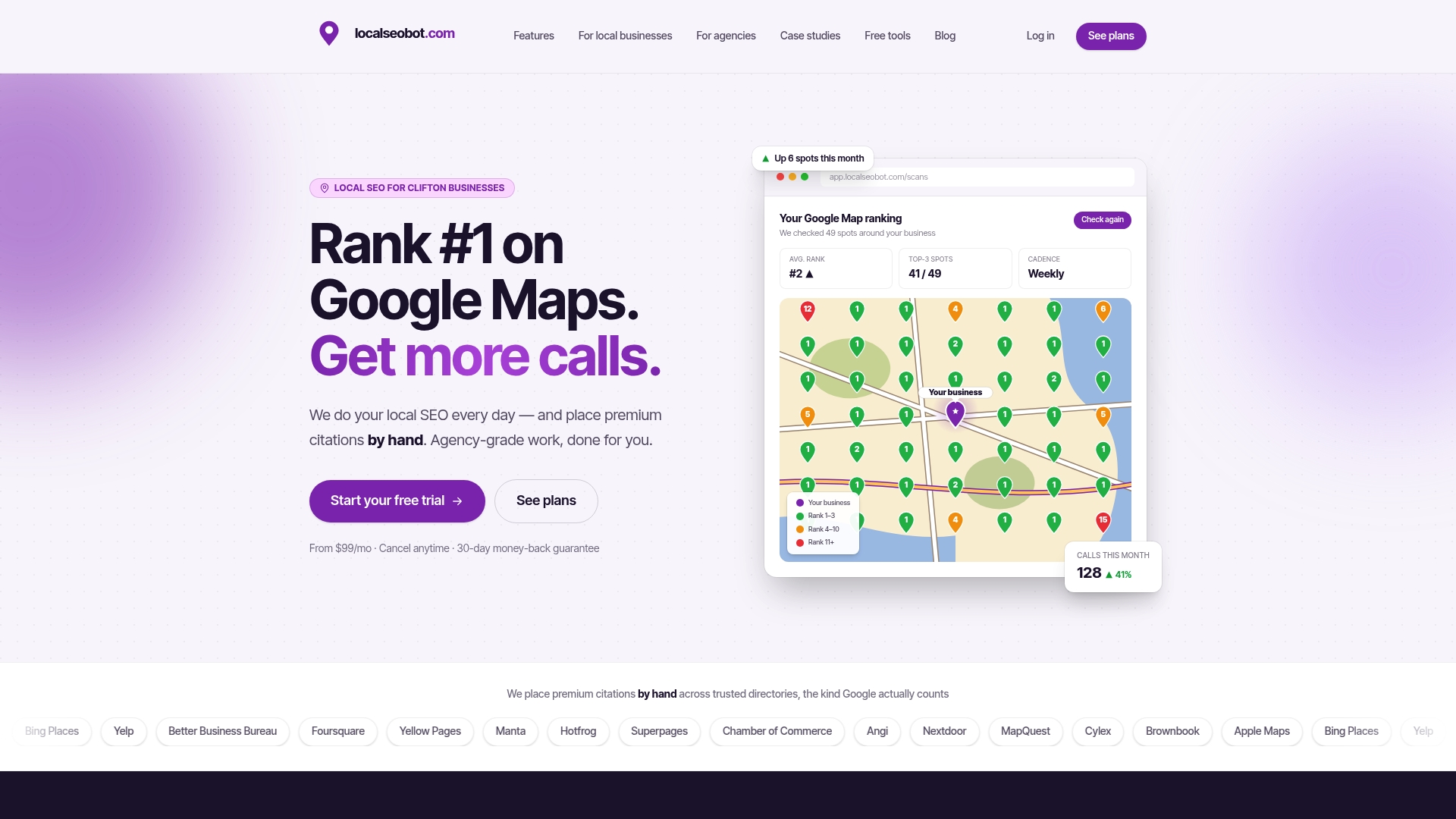
For agencies and multi-location owners, that means faster verification cycles, fewer sync errors, and a single dashboard to confirm every location is actually complete instead of guessing. Our local citation building service reinforces the same NAP consistency Bing rewards, and our team handles the manual work most automated tools skip entirely.
Run your current listings through the Local SEO Checklist Tool to see exactly which fields are missing before your next audit cycle.
Primary Sources And Further Reading
For technical steps straight from Microsoft, see Bing’s official listing management support page and the Bing Places for Business relaunch announcement. For broader tactics, Search Engine Land’s analysis of Bing Places and Semrush’s setup guide cover expanded strategy beyond the basics.
Sources
- Add and manage your business listing – Microsoft Support
- Optimizing for Bing Places: Is it worth it? – Search Engine Land (Mar 2023)
- Bing Places for Business: The Complete Optimization Guide – LocalDominator
- Bing Places for Business 2026: Setup and Optimization – TheStacc