Local Citations List: Priority Workflow and 8 Core Sites
Published September 4, 2026
Local Citations List: Priority Workflow and 8 Core Sites

Claim Google Business Profile, Apple Business Connect, Bing Places, Yelp, Facebook, Foursquare, BBB, and Yellow Pages first. These eight platforms carry the most weight for local pack visibility and Maps rankings, and they cost nothing to claim. Beyond that core group, you need a categorized expansion list covering aggregators, niche directories, and regional sites, plus a workflow for prioritizing which ones to tackle next and how to audit what’s already out there.
TL;DR:
- Claim and verify the eight core platforms, especially Google Business Profile and Apple Business Connect, as they heavily influence local rankings and visibility.
- Focus first on aggregators and niche directories after claiming primary sites, avoiding spreading efforts too thin across too many listings initially.
- Regularly audit and update citations to prevent data drift, using manual verification tools for high-value listings rather than relying solely on automated tools.
- Prioritize building rich, manually created citations on high-authority directories for better impact, especially when managing multiple locations.
- Use a phased approach, claiming the core eight first, then expanding to aggregators, niche sites, and local directories to maximize efficiency and local relevance signals.
Table of Contents
- The Core Citation Platforms Every Business Should Claim First
- The Expanded Local Business Directories List
- How to Prioritize and Claim Citations Without Wasting Time
- Keeping Your Citations Accurate After You’ve Built Them
- Why Manual Citation Building Still Wins
- How Localseobot Handles the Heavy Lifting
- Where to Verify Citation Data and Go Deeper
- Sources
The Core Citation Platforms Every Business Should Claim First
Curated lists from sources like BrightLocal consistently rank the same handful of platforms as non-negotiable. That consensus exists for a reason: these sites either feed Google’s local algorithm directly or control the map data other apps pull from. Skip one, and you’re leaving visibility on the table.
Here’s the shortlist, in order of impact:
- Google Business Profile — This is the primary driver of local pack rankings and Maps placement. If you claim nothing else, claim this.
- Apple Business Connect — Powers Apple Maps and Siri’s local results. iPhone users searching “near me” queries never see Google’s data at all, they see yours through this profile.
- Bing Places — Smaller search share than Google, but it feeds Microsoft’s ecosystem, including Windows voice search and Copilot’s local answers.
- Yelp — Still the default review hub for restaurants, home services, and retail. Even businesses that never asked for a Yelp page usually already have one, unclaimed.
- Facebook Page — Functions as a citation and a contact hub simultaneously. Many customers check hours and messages here before they check your website.
- Foursquare — Its consumer app faded years ago, but its point-of-interest data still feeds a long list of downstream apps and partners.
- Better Business Bureau — A BBB profile signals trust to both consumers and, indirectly, to algorithms weighing review consistency.
- Yellow Pages (YP.com) and MapQuest — Legacy directories, but they still show up in search results and still get crawled for NAP data.
The action item is the same for all eight: claim the listing, verify ownership, and match your name, address, and phone number exactly to your canonical version. A mismatched suite number or an old phone line still listed on Yellow Pages can quietly undercut the consistency signals Google checks when it decides how much to trust your business.
The Expanded Local Business Directories List
Once the core eight are locked down, the Podium approach of expanding outward to aggregators and niche sites becomes the right next move. Trying to do this in reverse, chasing hundreds of directories before securing your primary platforms, wastes time on sites with far less influence.
General directories worth claiming:
- YP.com, Manta, Superpages, Brownbook, and MerchantCircle round out the general-purpose layer. None of these move rankings the way Google or Apple do, but they add depth to your citation footprint and rarely take more than a few minutes each.
Maps and GPS platforms:
- HERE Map Creator, TomTom, and the Waze Map Editor feed navigation apps and in-car systems.
- MapQuest still gets used more than most business owners assume, especially for driving directions embedded in older websites.
- OpenStreetMap is worth checking too. It’s open-source, editable by anyone, and a surprising number of apps and services pull location data from it without most business owners realizing they’re listed there at all.
Data aggregators:
- Data Axle and Localeze don’t have consumer-facing storefronts you’d recognize, but they matter because dozens of downstream publishers and apps license their data instead of building their own directories. Getting your listing correct here ripples out to sites you’ll never directly interact with.
Vertical directories by industry:
- Home services: Angi, Thumbtack, Houzz
- Healthcare: Healthgrades, Zocdoc
- Legal: Avvo, FindLaw
- Hospitality and food: Tripadvisor, OpenTable
Regional and community directories, think local chamber of commerce sites or city-specific business guides, round things out. They rarely drive traffic on their own, but they reinforce the hyperlocal relevance signals that matter when someone searches for a business “near” a specific neighborhood rather than a whole city.
How to Prioritize and Claim Citations Without Wasting Time
Trying to submit to 500 directories in one sitting is how citation projects die halfway through. A tighter, sequenced approach gets more done with less burnout.
- Claim the core eight first. Google, Apple, Bing, Yelp, Facebook, Foursquare, BBB, and Yellow Pages come before anything else.
- Move to aggregators next. Data Axle and Localeze distribute your information to secondary directories automatically, so fixing errors here has a multiplying effect.
- Add your industry’s niche sites. A roofer belongs on Angi and Houzz; a dentist belongs on Healthgrades. Skip directories that don’t serve your category.
- Fill in regional and long-tail directories last, and only if you have bandwidth left.
For each listing, use an identical checklist: canonical NAP, your primary and secondary categories, a short unique description (never copy-pasted across every site), current photos, accurate hours, and defined service areas if you don’t have a storefront.
Pro Tip: Write your business description once, store it in a shared document, and reuse the exact wording everywhere. Directories that see inconsistent descriptions alongside inconsistent NAP data tend to trust the whole profile less.
Doing this yourself across 20 to 30 listings usually takes six to ten hours spread over a week, once you factor in verification delays. A managed service compresses that into days and avoids the duplicate-listing trap that trips up most DIY attempts.
Keeping Your Citations Accurate After You’ve Built Them
Citations decay. Phone numbers change, businesses move, and old duplicate listings resurface months after you thought they were merged. A quarterly audit, or one triggered immediately after any address or phone change, catches drift before it costs you rankings.
Manual citation building has a real advantage here: it creates a permanent record you own, with richer data like photos and full descriptions, rather than a thin auto-synced entry that disappears the moment a subscription lapses.
A basic audit routine looks like this:
- Run a citation discovery check to surface every existing listing, including ones you never created.
- Compare each result against your canonical NAP for mismatches.
- Flag and merge duplicates before they split your review counts and local signals.
- Log every login and listing in one shared document so updates don’t fall through the cracks when staff changes happen.
Tools built specifically for this, like a citation consistency analyzer, catch mismatches far faster than manually checking each site by hand.
Why Manual Citation Building Still Wins
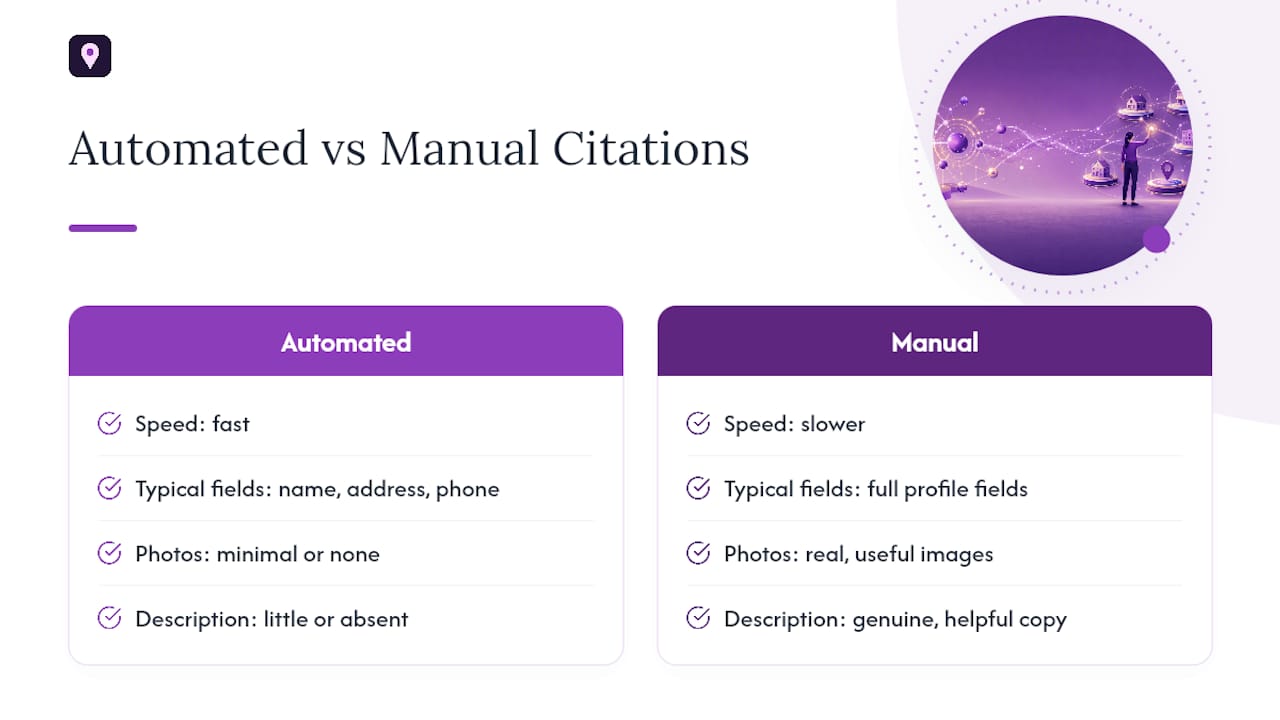
Automated citation tools promise speed, and they deliver it. What they don’t deliver is depth. A synced listing typically carries your name, address, and phone number and little else, while a manually built profile can carry real photos, a genuine description, and service details that actually help a customer decide to call.
DIY works fine for a single-location business with time to spare. Once you’re managing multiple locations, or you’ve already tried the free tools and still aren’t seeing movement, that’s the point where a specialist starts paying for itself.
— Local
How Localseobot Handles the Heavy Lifting
Building and auditing a full citation list by hand is doable, but it’s also the exact kind of repetitive, detail-heavy work that eats an entire weekend and still leaves gaps. Some local SEO services take a different route than most automated citation tools: instead of syncing thin data across hundreds of low-value sites, they focus on manually building premium citations on high-authority directories that influence Google Maps rankings.
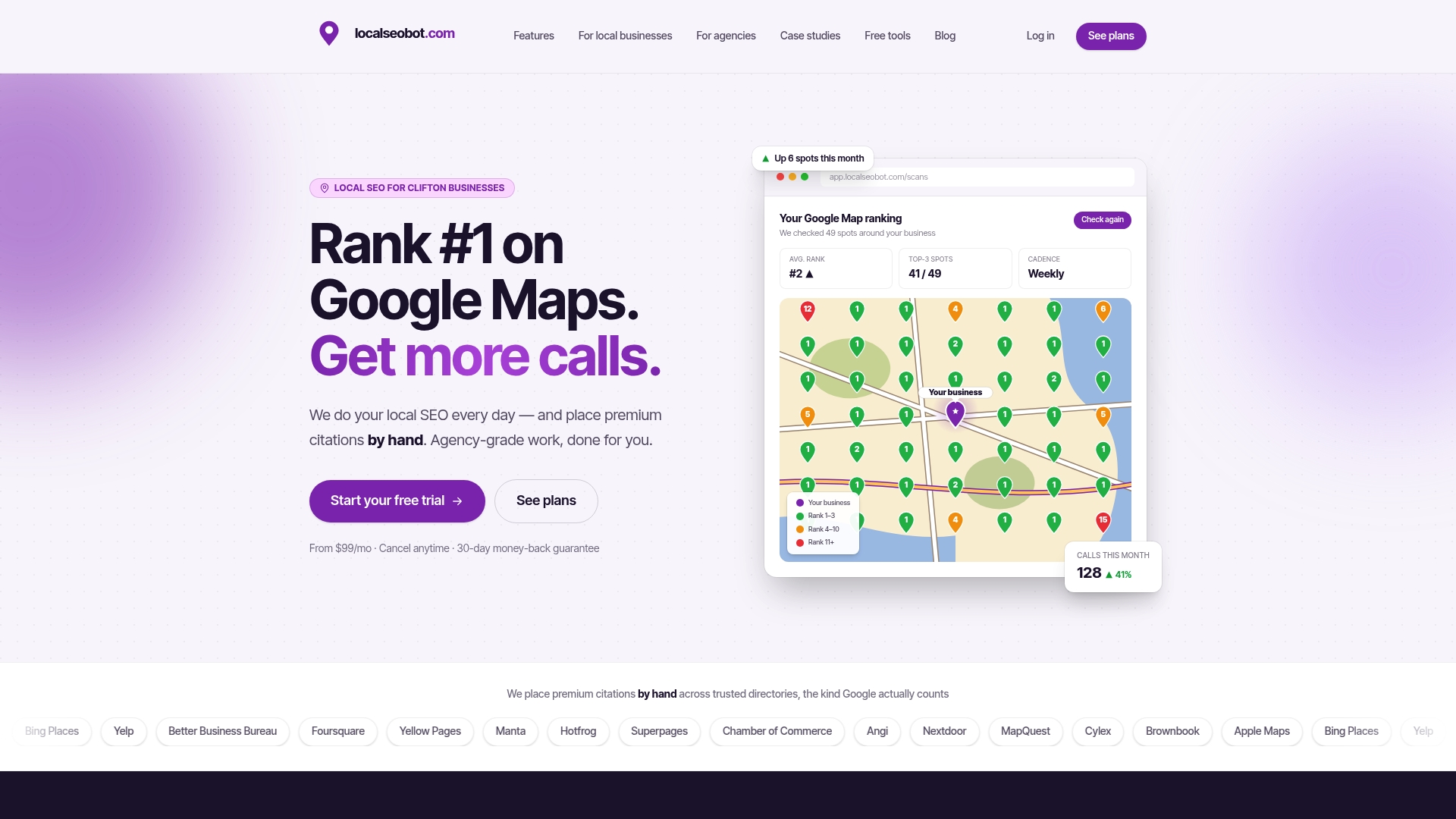
Start with the Local Citation Finder to see exactly which listings exist, which are missing, and where your NAP data has drifted out of sync. Pair that with the Citation Consistency Analyzer to catch mismatches before they quietly cost you rankings. If you’d rather hand the whole process off, the managed citation services come backed by a 30-day money-back guarantee if your rankings don’t improve. Run a free audit today and see exactly where your listings stand.
Where to Verify Citation Data and Go Deeper
For citation counts and category breakdowns beyond this list, a few resources are worth bookmarking:
- Podium’s directory overview for a clear breakdown of which listings are free versus paid.
- W3era’s regularly updated citation roundup for a quick reference table when you need a second opinion on a niche directory.