3–10 Location Pilot to Scale Multi Location Review Management for SMBs
Published September 1, 2026
3–10 Location Pilot to Scale Multi Location Review Management for SMBs

The fastest way to stop reputation leakage across a network is a centralized review hub paired with hybrid governance and a strict 24-hour response protocol. Corporate owns monitoring, brand voice, and escalation rules; local teams own the daily replies. Pilot this with 3 to 10 locations before rolling out network-wide, and hold every location to the same response-rate target industry leaders already use.
TL;DR:
- Centralized dashboards with alert thresholds are essential for managing review volume and identifying unusual activity across multiple locations.
- Clear ownership separation assigns corporate responsibility for infrastructure and escalation, while local teams handle daily responses and personalization.
- Response targets should be 85–90% within 24 hours, with at least 50 reviews per location monthly, aiming for 100+ in competitive markets.
- Piloting with a mix of top and bottom performers reduces adoption risk and helps refine templates, escalation rules, and training for full network rollout.
- Effective review management requires a disciplined operational approach focused on roles, escalation protocols, and consistent follow-through, not just automation.
Table of Contents
- Why Multi-Location Review Management Breaks Down at Scale
- The Hybrid Model: What Corporate Owns vs. What Local Teams Do
- Your Step-by-Step Playbook for Managing Reviews Across Locations
- What Your Review Management Tech Stack Actually Needs
- What Metrics Actually Prove Your Review Program Is Working
- Your 90-Day Rollout: From Pilot to Full Network Adoption
- The Evidence Behind This Playbook
- What Most Brands Get Wrong About Scaling This
- Pilot Local SEO Bot Before You Scale Your Review Program Network-Wide
- Sources
Why Multi-Location Review Management Breaks Down at Scale
Managing reviews for one location is a task. Managing them for 30, 100, or 500 locations is an operations problem, and most brands try to solve it with a marketing solution.
The volume alone overwhelms untrained teams. Every location generates its own stream of reviews across Google, Yelp, and Facebook, and someone has to log into each profile separately unless there’s a unified system. That fragmentation is expensive in a way that doesn’t show up on a budget line: it’s the switching cost of jumping between a dozen browser tabs every morning.
Brand drift is the second failure point. When 50 different managers write 50 different versions of “we’re sorry you had a bad experience,” the brand starts to sound like 50 different companies. Inconsistent tone erodes the trust that made the brand recognizable in the first place, and it sends mixed signals to Google’s ranking systems about how actively a business location is managed.
Then there’s risk concentration. A review alleging a safety violation, discrimination, or legal issue at one location isn’t a local problem. It’s a corporate liability the moment it’s public, and a manager without escalation training will either ignore it or make it worse.
Common failure modes to watch for:
- Location logins sit unused because the dashboard feels like one more task nobody assigned.
- One-star reviews go unanswered for a week or longer, tanking the average response time.
- A single disgruntled competitor or coordinated attack pushes a location’s rating down before anyone notices.
- Local managers, under pressure to boost volume, start offering discounts for reviews, which Google’s Maps content policy classifies as rating manipulation.
The Hybrid Model: What Corporate Owns vs. What Local Teams Do
The brands that scale review management well split ownership deliberately instead of leaving it to whoever happens to check the dashboard that week. Corporate builds the system; local teams run it day to day. This is the same logic that separates a franchise’s operations manual from its store managers, and it works here for the same reason.
- Corporate owns the infrastructure. That means the centralized monitoring dashboard, the brand voice guidelines, the response template library, the escalation thresholds, and the roll-up reporting that goes to leadership.
- Local teams own execution. Daily monitoring, fact-checking the specifics of a complaint, personalizing the reply with real details, and knowing when a review is above their authority to handle alone.
- Escalation rules draw the line. Legal threats, safety allegations, discrimination claims, and press-worthy incidents route straight to corporate. Service complaints, wait times, and product quality issues stay with the location.
Splitting ownership this way prevents two opposite failures: robotic corporate replies that ignore local context, and unmanaged complaints that slip through because nobody owned the response. Getting local managers to actually use the system matters as much as the system itself. Single sign-on, a mobile-first interface, and a scorecard that shows each location its own response rate and rating trend tend to drive far better login habits than a generic enterprise portal that assumes everyone has time to learn a new tool.
Your Step-by-Step Playbook for Managing Reviews Across Locations
This is the operational sequence to follow, roughly in order. Skipping steps is how pilots stall.
- Centralize visibility first. Pull every location’s reviews into one dashboard and set alerts for anything under three stars, plus alerts for unusual velocity, like a location suddenly getting ten reviews in a day when it normally gets two.
- Build the template library before you launch. Write response templates for the five most common scenarios (service delay, staff complaint, product issue, praise, and safety concern), each with variables for the manager’s name, the location, and specific details.
- Set the 24-hour SLA and back it with escalation thresholds. Every review gets an initial response within 24 hours. One and two-star reviews escalate to a regional supervisor if unanswered after 12 hours; anything mentioning legal or safety issues escalates immediately.
- Generate reviews the compliant way. Post-visit text or email links, a QR code on the receipt, or a follow-up ask from staff all work. What doesn’t work, and what Google explicitly prohibits, is offering a discount for a review or asking for one while the customer is still standing at the counter.
- Automate triage, not judgment. Sentiment tagging and topic clustering can flag which reviews mention “rude staff” or “long wait” across the network, but a human still decides how to respond to anything sensitive.
- Pilot before you scale. Roll the system out to a handful of locations, measure adoption honestly, and fix the templates and alert rules before asking the whole network to use them.
Pro Tip: Pick your pilot locations deliberately. Include one of your best-performing sites and one of your worst. The top performer proves the system works when management is already engaged; the bottom performer reveals the actual adoption problems you’ll face everywhere else.
Consistency across dozens of storefronts also depends on training that goes beyond a one-time onboarding email. Managers need refreshers on tone, on what counts as an escalation, and on how to personalize a template without breaking brand voice. A step-by-step negative review response guide works better as a living reference than a PDF nobody reopens after week one.
What Your Review Management Tech Stack Actually Needs
Vendor selection gets confusing fast because most platforms describe features instead of capabilities. Evaluate against these categories instead, whether you’re buying software or scoping an internal build.
- Aggregation and alerting. The tool has to pull reviews from every profile you operate on and let you set custom alert thresholds by star rating and by velocity, not just a generic daily digest.
- Governance and workflow. Role-based access controls, approval gates for sensitive replies, and a centralized template library that local users can customize within limits, not rewrite from scratch.
- Operational usability. A mobile app, single sign-on, and a fast onboarding flow per location. If it takes 45 minutes to train a store manager, expect a low adoption rate.
- Analytics and integrations. Sentiment analysis, topic clustering across locations, and an export or API path into whatever BI tool leadership already uses for reporting.
- Compliance safeguards. Built-in guardrails that prevent bulk review requests that look incentivized, plus an audit log of who sent what and when.
Fake and low-quality reviews are a growing enough problem that some platforms now build in automated quality scoring to flag spam, ads, and irrelevant content before it reaches a manager’s queue, similar to the multi-label classification approaches researchers have built for this exact purpose. On the detection side, emerging verification techniques use location permissions or photo metadata to confirm a reviewer actually visited, and separate linguistic research found that reviews written by actual visitors use more concrete, experiential language, with classification models reaching roughly 0.72 to 0.73 F1 accuracy distinguishing visit from non-visit reviews. None of that replaces human judgment, but it’s a preview of where review quality control is headed.
What Metrics Actually Prove Your Review Program Is Working
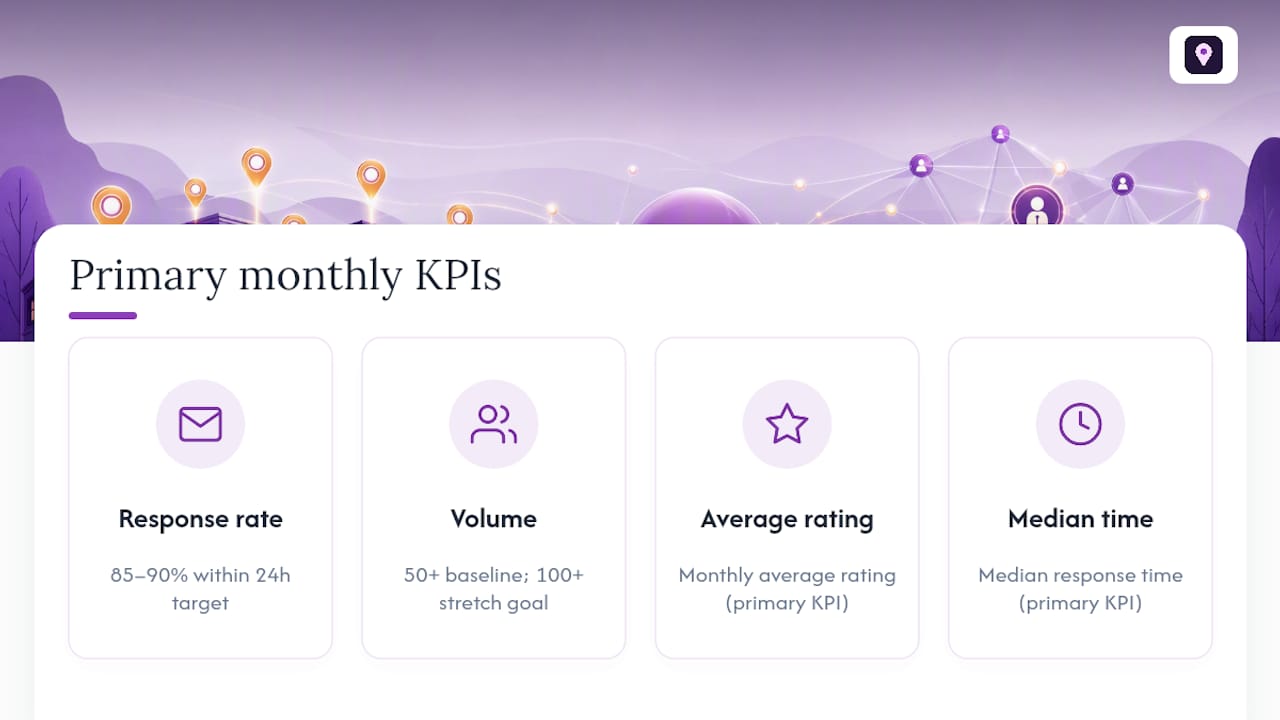
Four numbers belong on every location’s monthly scorecard, and they’re not complicated to track once the dashboard is centralized.
Target: 85–90% response rate within 24 hours, with 50 or more reviews per location as a baseline volume target and 100+ as the stretch goal for competitive markets, based on benchmarks used across franchise review programs.
Average rating and median response time round out the primary KPIs. Secondary metrics worth tracking include sentiment trend over the trailing 90 days, changes in local map ranking position, and any measurable lift in calls or bookings tied to review improvements.
For a scorecard rollup, rank locations by response rate first, since that’s the fastest metric to fix, then layer in rating and volume.
Your 90-Day Rollout: From Pilot to Full Network Adoption
Run this on a calendar, not a wish list.
- Weeks 1 through 4: Select 3 to 10 pilot locations spanning your best and worst performers. Set up the dashboard, load the template library, configure alert rules, and onboard operators with SSO and mobile access.
- Weeks 5 through 8: Run the pilot live. Hold weekly KPI check-ins on response rate and time-to-first-response, and refine templates and escalation routing based on what’s actually breaking.
- Weeks 9 through 12: Expand to the next cohort of locations. Introduce a leaderboard and small non-monetary recognition for engaged managers, and lock in the executive reporting cadence for the full rollout.
Pro Tip: Keep the pilot’s first login task down to two things: check the dashboard and answer one flagged review. Operators who succeed at something simple on day one come back on day two.
Real rollouts using this hybrid structure have moved response rates from around 41% to roughly 89% within 60 days, with median response time dropping from over six days to about 18 hours, according to case data from franchise review programs.
The Evidence Behind This Playbook
Franchise data backs the targets in this playbook directly: brands aiming for an 85–90% response rate within 24 hours consistently outperform networks still averaging closer to 35% response specifically on negative reviews. Google’s own policy sets the compliance floor, prohibiting incentivized or pressured reviews outright.
Governance and escalation clarity, not clever automation, are what make a review program survive contact with 50 different store managers.
Localseobot’s own work building manual, high-authority citations for small businesses reflects the same principle: clients report measurable ranking gains, backed by a 30-day money-back guarantee, because consistency and follow-through beat one-off automation every time.
What Most Brands Get Wrong About Scaling This
Most advice treats review management as a marketing checkbox: post a template reply, move on, report the star rating up the chain once a quarter. That framing misses the actual lever. The brands that improve fastest treat this as an operations discipline with the same rigor as inventory or scheduling: defined roles, escalation paths, and a scorecard someone actually reviews weekly.
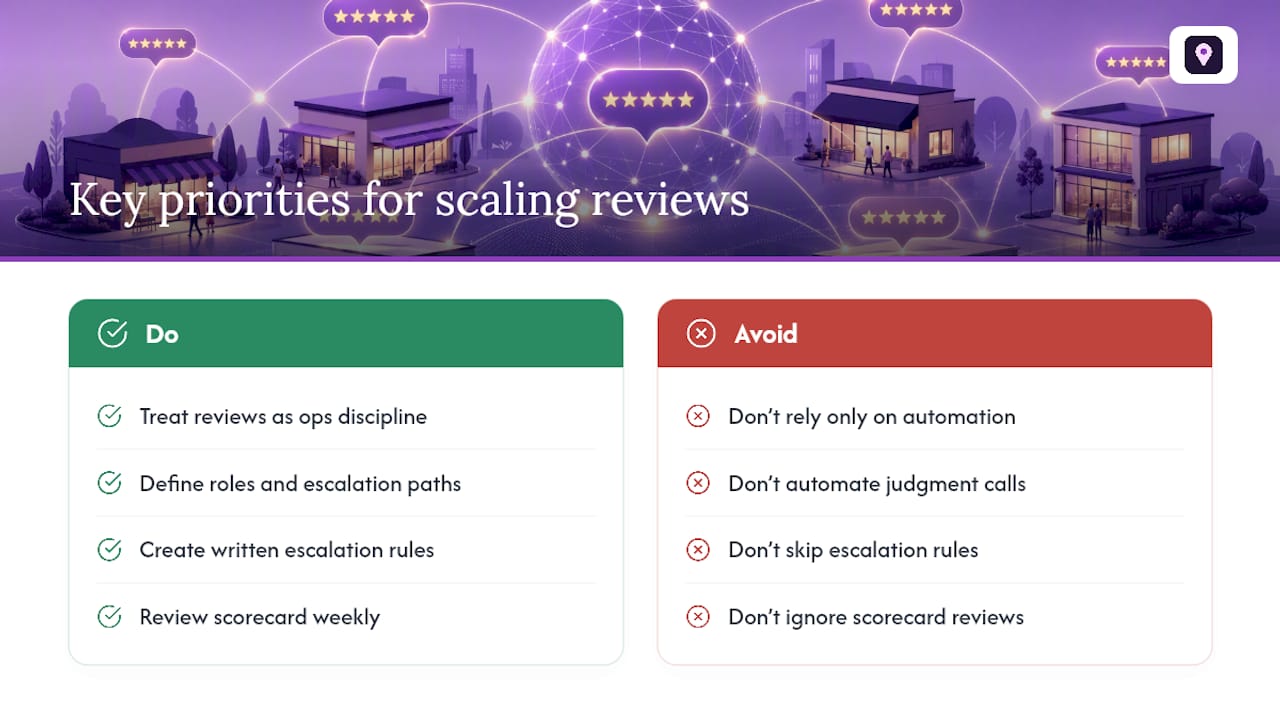
The overrated piece is automation itself. AI-assisted sentiment tagging and auto-drafted replies save time, but they can’t judge whether a complaint about “unsafe conditions” needs a lawyer or just an apology. Automate the triage, never the judgment call.
What deserves priority first isn’t the tech stack. It’s the escalation rulebook. Decide, in writing, which reviews a local manager can answer alone and which ones go up the chain before a single review ever misses a response. Every brand that skips this step ends up rebuilding it after a preventable crisis, usually the expensive way.
— Local
Pilot Local SEO Bot Before You Scale Your Review Program Network-Wide
Localseobot built its Google Reviews Management Tool around the exact hybrid model this playbook describes: one dashboard for monitoring every location, AI-drafted replies your local managers can personalize before sending, and automated review generation that stays within Google’s rules rather than pushing incentivized asks.
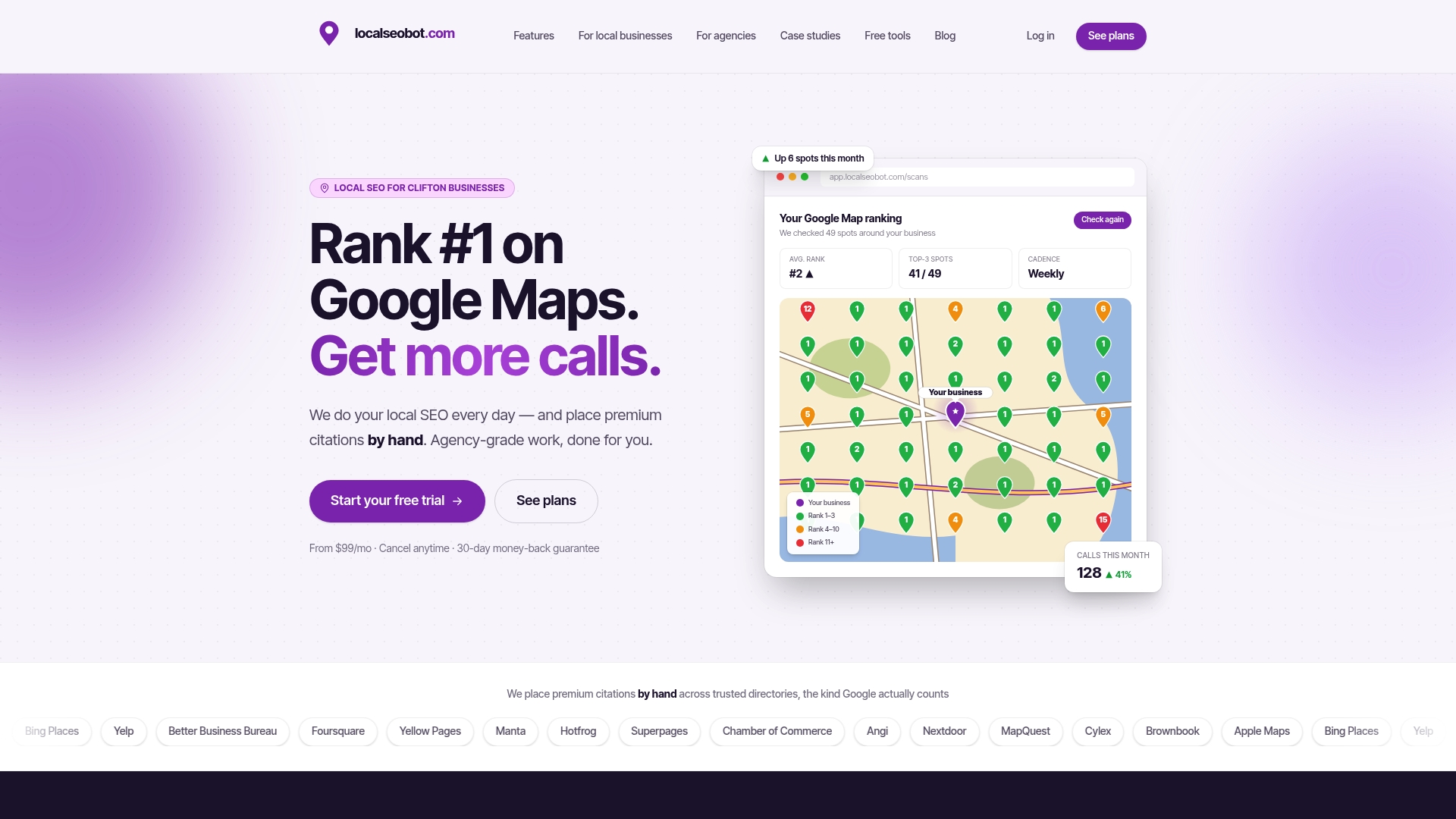
It fits mid-size multi-location brands and agencies best, the kind of operation stuck between spreadsheets that don’t scale and enterprise platforms priced for national chains. Localseobot pairs that dashboard with manually built, high-authority citations across directories, the same hands-on work that’s earned client-reported ranking gains on Google Maps, backed by a 30-day money-back guarantee if rankings don’t move.
Start with a pilot group of your own locations and see the response-rate difference in the first month. Set up your Google Reviews Manager dashboard and run the same 3-to-10 location test this playbook recommends before committing the whole network.
Sources
- Prohibited & restricted content - Maps User Generated Content Policy Help
- Franchise Review Management: The Multi-Location Playbook That Scales
- Techniques to verify location-based reviews (disclosure / patent-style description)
- Visit experience judgement research (ACL findings paper)